

How to write official correspondence
The Official Correspondence guidelines provide recommended standards for preparing letters and other formal communications on behalf of the SEA DREAM Programme. They serve as a reference for formatting and writing official correspondence while allowing flexibility to accommodate different communication needs and institutional requirements.
Official correspondence issued on behalf of the SEA DREAM Programme should use the official SEA DREAM letterhead and follow the formatting standards below.

Letter Format
Page Format:
- Font: Aptos, 11pt /12 pt
Font size may be adjusted slightly for unusually short or long letters - Alignment: Justified
- Line spacing: Single
- Paragraph spacing: Add one blank line between paragraphs
- Paragraph indentation: None
Logo:
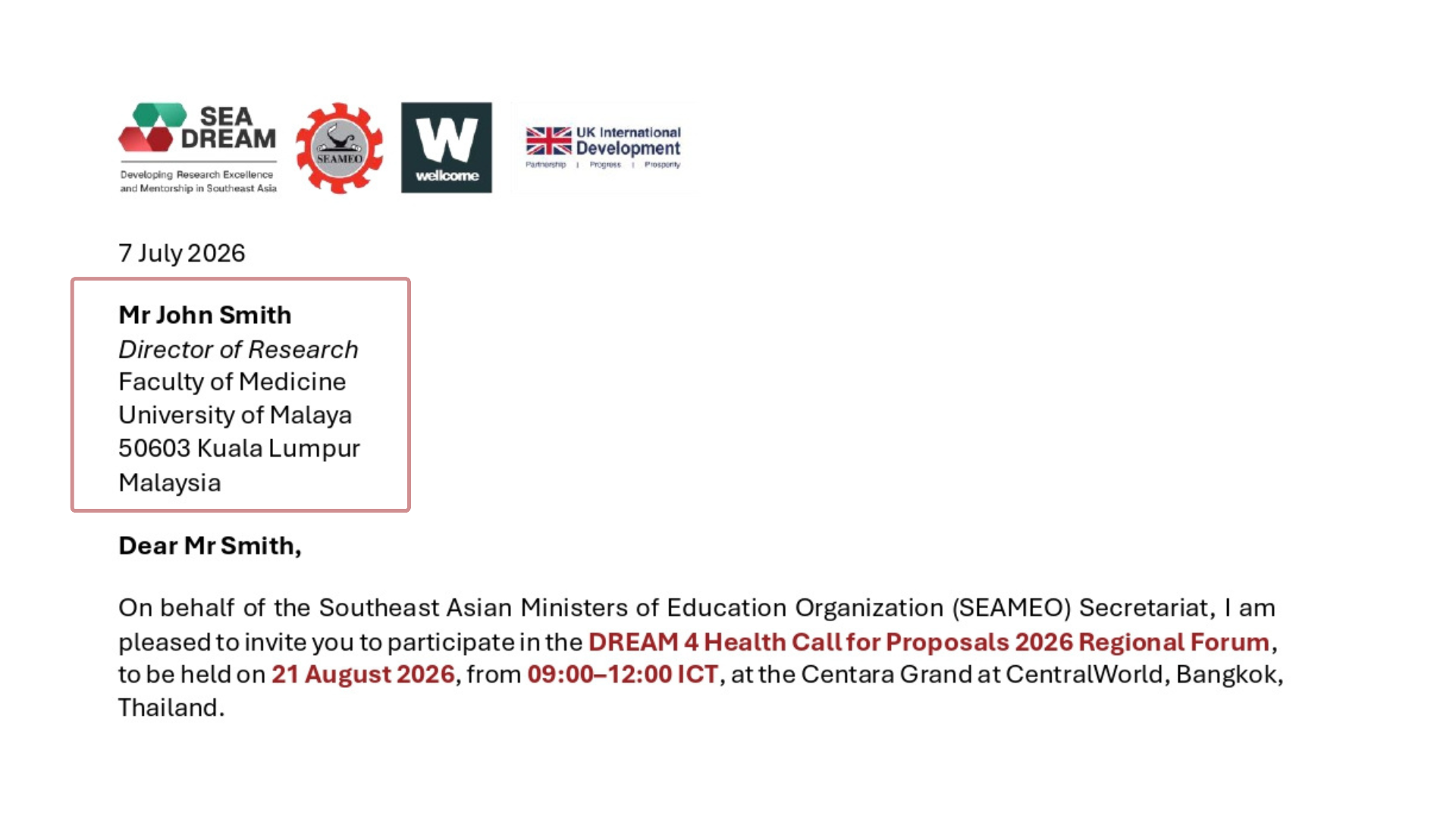
Use the full-colour SEA DREAM partner logo.
Date:
Use the day-month-year format without commas.
Letter Structure
Addressee
- Place the recipient's name, title, organisation, and address at the top left of the first page.
- Use the recipient's official title where applicable.
- Format the addressee's full name in bold.
- Format the addressee's position in italics.
Minister of Education
Ministry of Education
Rajdamnoen Nok Avenue
Dusit, Bangkok 10300
Thailand
Chairperson
SEAMEO Secretariat
Bangkok, Thailand
Salutation
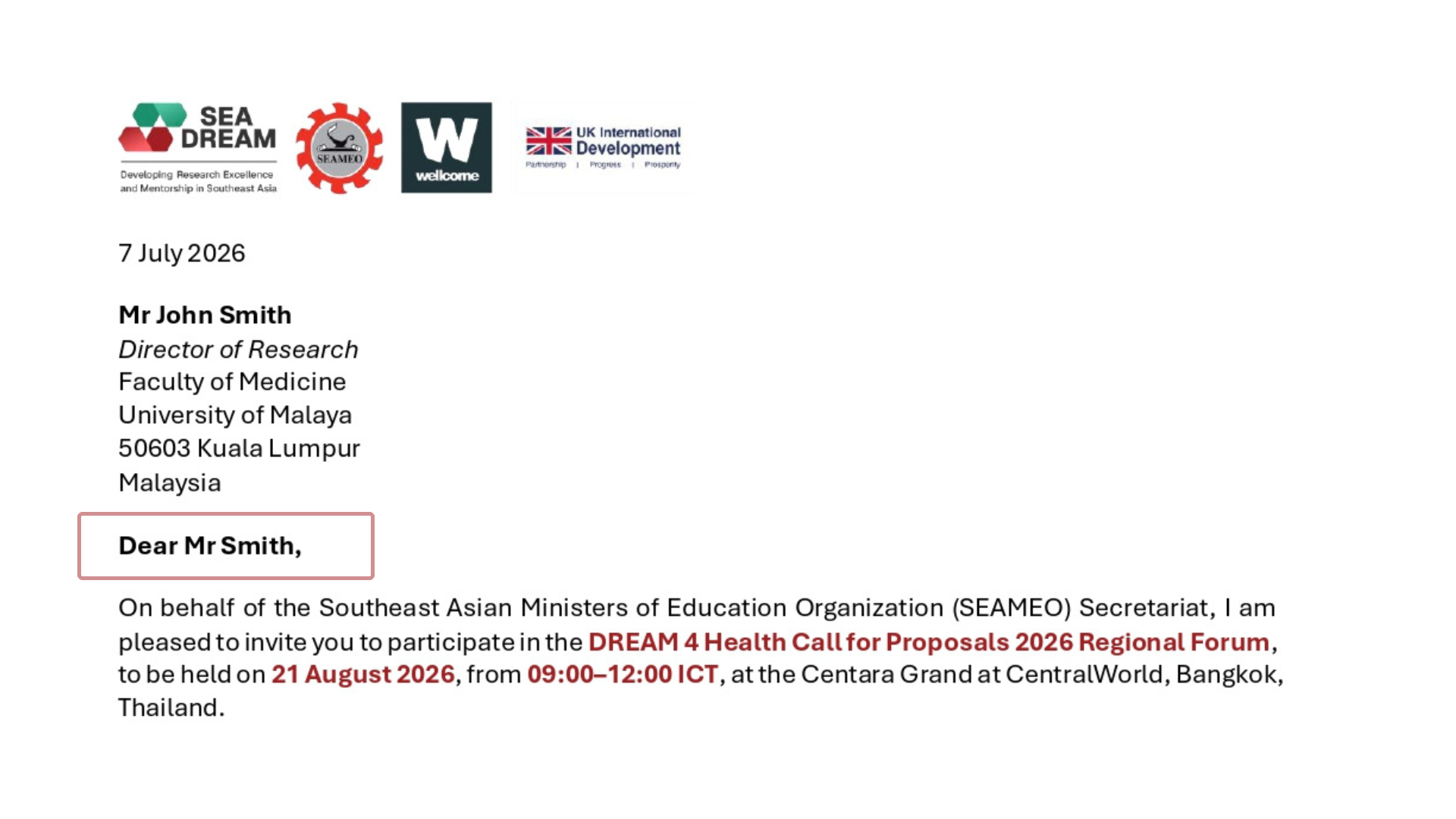
- Your Excellency,
- Dear Prof Dr Adul,
- Dear Dr Santos,
- Dear Ms Tan,
- Dear Mr Lee,
- Prof Dr ✔
- Mr ✔
- Ms ✔
- Prof. Dr. ✘
- Dr. ✘
- Mr. ✘
Body
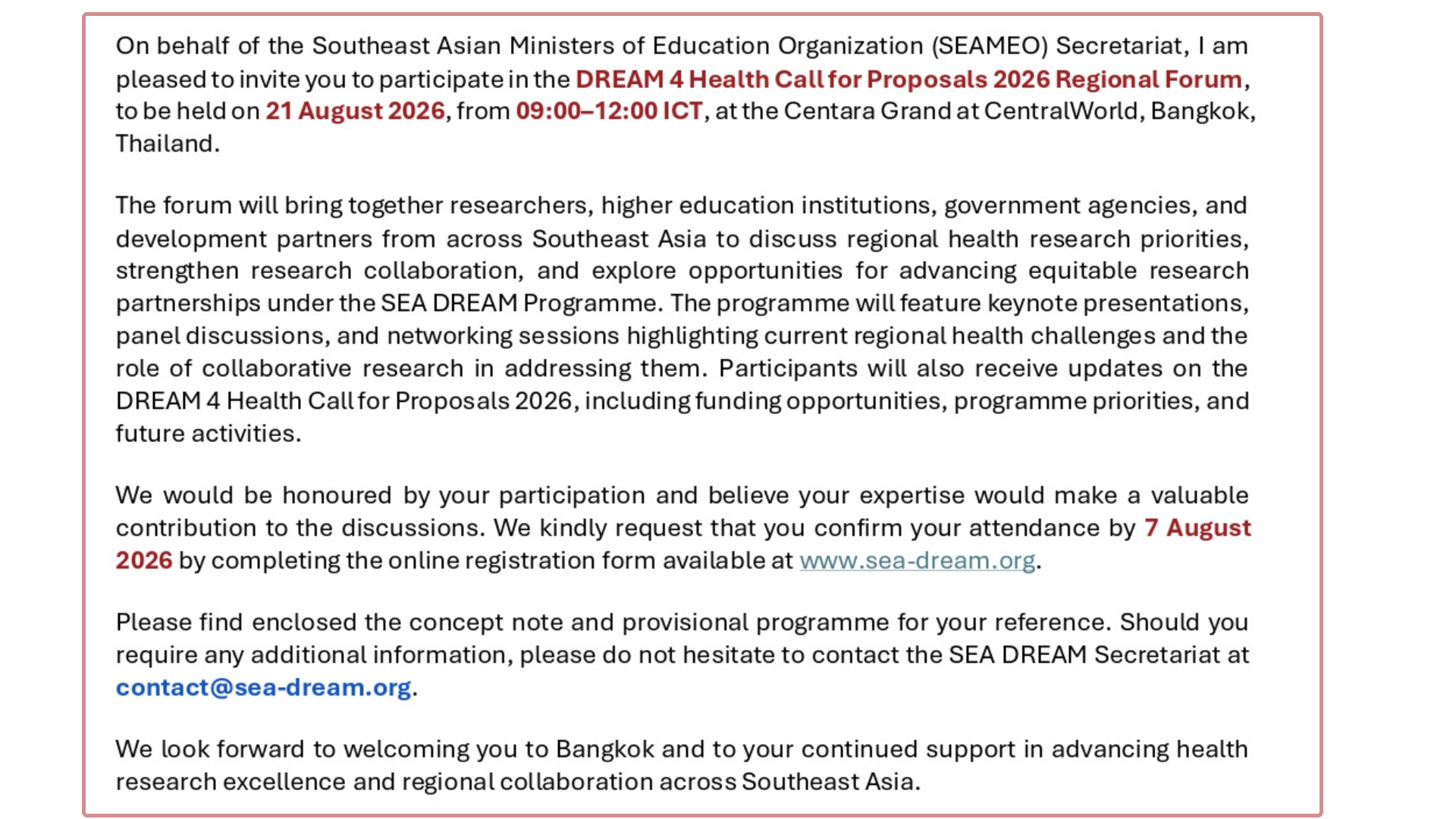
- Use clear, professional, and concise language.
- Keep paragraphs short and focused.
- Leave one blank line between paragraphs.
- Use justified text alignment.
- Avoid unnecessary jargon, repetition, and overly complex sentences.
- Use formatting sparingly to emphasise key information.
- Bold the title of the event, activity, or main purpose of the letter.
- Highlight important dates, deadlines, and response requirements in bold using Carmine Red (Hex: #A22023).
- Avoid excessive use of bold, colour, or italics elsewhere in the letter.
Recommended Structure
The structure of an official letter may vary depending on its purpose; however, the following sequence is recommended.
Opening Paragraph: Introduce the organisation issuing the letter, including any partner organisations where appropriate. Clearly state the purpose of the correspondence.
Supporting Information: Provide relevant background information, such as the event, activity, initiative, or request. Include any information necessary for the recipient to understand the context.
Action Required: Clearly state any action expected from the recipient, including deadlines, confirmation requirements, or requested documents.
Closing Information: Provide contact details for further enquiries and refer to any enclosed documents where applicable.
Closing Paragraph: Conclude with a courteous closing statement expressing appreciation, anticipation of the recipient's response, or continued collaboration before the complimentary close.
Complimentary Close and Enclosure
- Please accept, Your Excellency, the assurances of my highest consideration.
For other recipients, use:
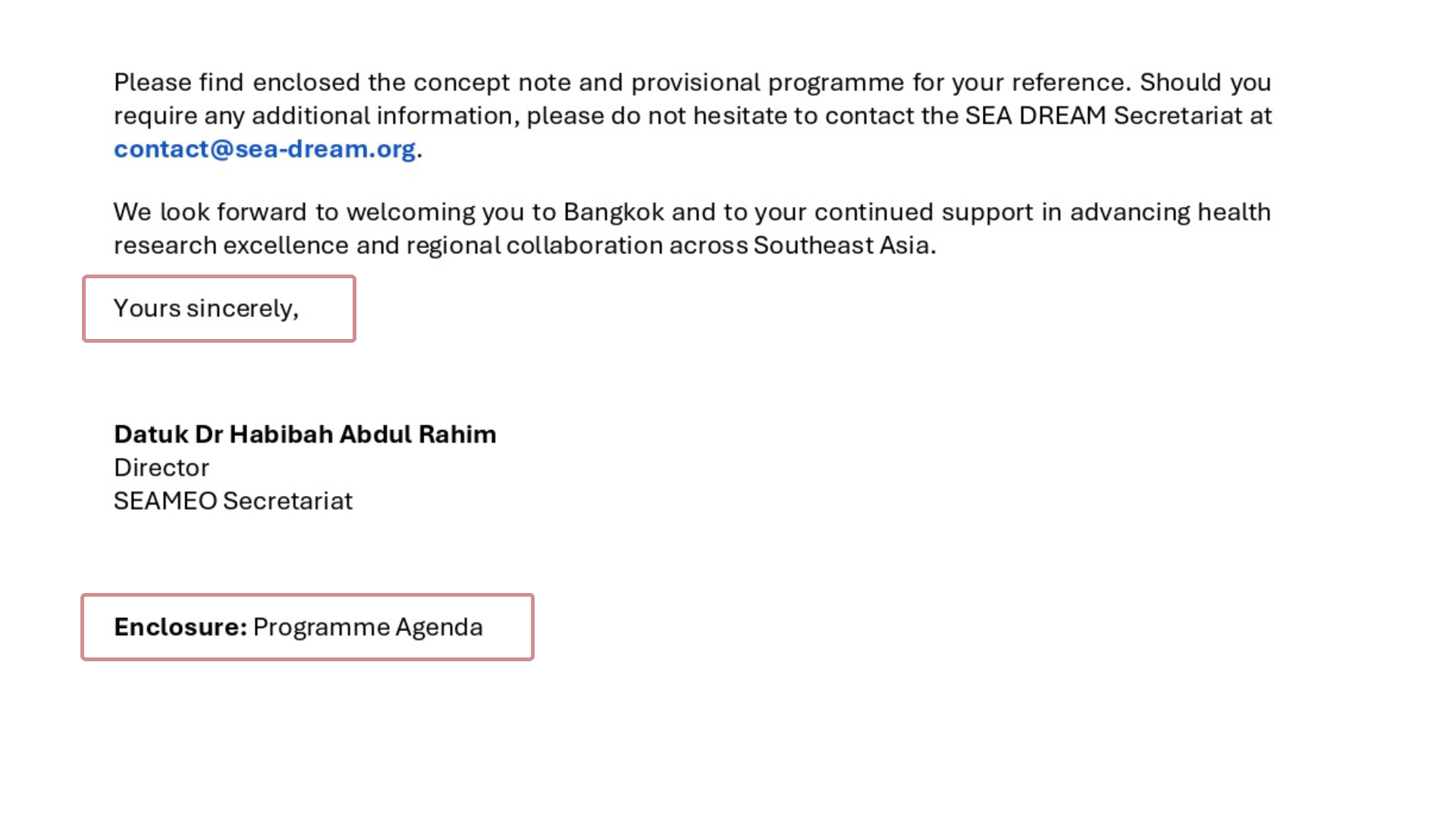
- Yours sincerely,
If documents accompany the letter, refer to them within the body of the letter and indicate them below the signature.
- Programme Brochure
- Call Guidelines
- Programme Agenda
Naming Conventions
Naming conventions vary across Southeast Asia. When corresponding with individuals, always verify and use their preferred form of name and title.
| Country | Preferred reference |
|---|---|
| Cambodia | Most names consist of two short words. Use both names throughout. |
| Indonesia | Many individuals have a single name or no family name. When a name consists of two words, generally use the first name. In some cases, both names are used throughout. |
| Lao PDR | For names consisting of two words, always use the first name. |
| Malaysia | Malays generally do not have family names. Instead, the father's given name forms the second part of the name. Use the first name. The terms bin (son of), binti (daughter of), and Haji may be omitted where appropriate. Given names may also include compounds such as Abdul, Mohammed, or Syed. |
| Myanmar | Many individuals have only one name. When a name consists of two words, use both names throughout. |
| Philippines | Use the last name after the first reference. |
| Singapore | Three-syllable Chinese names do not use a hyphen between the last two syllables. Use the first name. For two-word names, use the second name. |
| Thailand | Use the first name. |
| Vietnam | Names usually consist of three words without hyphens, although some consist of two words. Generally, use the last name. |
When in doubt, use the form of name shown in the person's email signature, business card, institutional website, or previous correspondence.