

Editorial Guidelines
Voice
SEA DREAM communicates with a voice that reflects its commitment to scientific excellence, regional collaboration, and equitable partnerships. All communications should be clear, credible, and accessible while remaining respectful of diverse audiences across Southeast Asia.

Maintain a confident, respectful, and authoritative tone that reflects SEA DREAM's role as a trusted regional health research programme.

Write in a way that is approachable, human, and relevant, encouraging collaboration while making complex topics easy to understand.

Communicate ideas clearly and efficiently by avoiding unnecessary words, repetition, and overly technical language where possible.

Ensure all information is factually correct, evidence-based, and consistent with SEA DREAM's official policies, terminology, and messaging.
Spelling
SEA DREAM follows British English.
Spelling should follow the current Oxford English Dictionary (OED) and Oxford Languages, using the preferred British spelling where variants exist. Examples include:
| British | American |
|---|---|
| organisation | organization |
| recognise | recognize |
| prioritise | prioritize |
| analyse | analyze |
| behaviour | behavior |
| programme | program* |
| colour | color |
| centre | center |
| labour | labor |
| travelling | traveling |
*Use programme except when referring to software or computer programs.
Always follow the official spelling of organisations, publications, or proper names.
Correct Examples:
- Southeast Asian Ministers of Education Organization (not Organisation)
- Centers for Disease Control and Prevention (CDC) (not Centres)
Quotation Marks
Use quotation marks consistently to distinguish quotations from titles and specialised terms.
Single quotation marks (' ')
Use single quotation marks for:
- titles of articles or reports
- conference themes
- slogans
- specialised terms on first reference
- letters or words discussed as words
Example:
- The conference theme was 'Building Research Equity Across Southeast Asia'.
Double quotation marks (" ")
Use double quotation marks only for direct quotations or spoken dialogue.
Example:
- One of the participants stated, "Regional collaboration is essential to strengthening health research."
Bulleted Lists
Use bullet points to improve readability while maintaining consistent punctuation and formatting.
Complete sentences
If each bullet is a complete sentence, begin with a capital letter and end with a full stop.
Example:
SEA DREAM supports regional health research through the following initiatives:
- The programme strengthens research partnerships across Southeast Asia.
- It promotes equitable collaboration among consortium members.
- It invests in the next generation of health research leaders.
Introductory stem
If an introductory statement leads directly into the bullet points, each item should complete the sentence. Begin each item with a lowercase letter (unless it is a proper noun). Omit punctuation for short items.
Example:
SEA DREAM supports health research by:
- strengthening regional research partnerships
- building institutional research capacity
- investing in future research leaders
Words or short phrases
If the bullet points consist of words or short phrases rather than sentence fragments, begin each item with a lowercase letter (unless it is a proper noun) and omit punctuation.
Example:
SEA DREAM's thematic priorities include:
- infectious diseases
- mental health
- climate change and health
- strengthening health systems and access to care
Inclusive Language
SEA DREAM is committed to respectful, inclusive, and equitable communication. Language should reflect the diversity of people, institutions, and communities across Southeast Asia while avoiding stereotypes or discriminatory expressions.
Use inclusive language
- Use gender-neutral terms where possible.
- Avoid assumptions based on gender, ethnicity, nationality, disability, religion, or age.
- Refer to people respectfully using their preferred names and pronouns when known.
- Emphasise people before conditions or characteristics where appropriate (for example, people living with disabilities where this aligns with preferred terminology).
| Instead of | Use |
|---|---|
| manpower | workforce / staffing |
| chairman | chair / chairperson |
| principal investigator and his team | research team / the Principal Investigator and the research team |
| developing countries | low- and middle-income countries (LMICs), where appropriate |
| vulnerable groups | people or communities in vulnerable situations |
| beneficiaries | participants / communities / partners (depending on the context) |
| boys and girls | children |
| mankind | humanity / humankind |
Whenever possible, use plural constructions to avoid unnecessary gendered pronouns.
Example:
Instead of
- A researcher must submit his report.
Use
- Researchers must submit their reports.
Numbers
Spell out numbers one to nine and use numerals for 10 and above, except when a number begins a sentence.
Example:
SEA DREAM supports regional health research through the following initiatives:
- Three consortiums participated.
- The programme funded 12 research projects.
- Twenty researchers attended the workshop.
Dates
Use the day-month-year format without commas.
Example:
-
15 January 2026 ✔
-
7 July 2026 ✔
-
January 15, 2026 ✘
Time
Use the 24-hour clock and always include the applicable time zone for meetings, events, webinars, deadlines, and other time-sensitive communications. Use the appropriate time zone abbreviation or UTC/GMT offset where relevant.
Example:
-
09:00 ICT ✔
-
14:30 GMT+7 ✔
-
09:00–17:00 ICT ✔
Hypenation
Use hyphens only where they improve clarity or are part of established terminology.
Example:
- early-career researcher
- evidence-based policy
- multi-country consortium
- region-wide initiative
- decision-making
Do not hyphenate commonly accepted terms.
Example:
- healthcare
- stakeholder
Punctuation
Apply British English punctuation consistently throughout all communications.
- Use one space after full stops, commas, colons, semicolons, and other punctuation marks. Do not insert multiple spaces between sentences.
- Use the serial (Oxford) comma only where it improves clarity.
Example:
- The consortium includes researchers from Cambodia, Malaysia and Thailand.
- The keynote speakers included the Minister of Health, the Director-General, and the Programme Director.
(The comma before "and" clarifies that these are three separate individuals.)
Use en dashes (–) for ranges.
Example:
- 2026–2030
- Pages 12–18
- Monday–Friday
References to Figures and Tables
References to figures, tables, charts, and panels should appear in parentheses at the end of the relevant sentence.
Example:
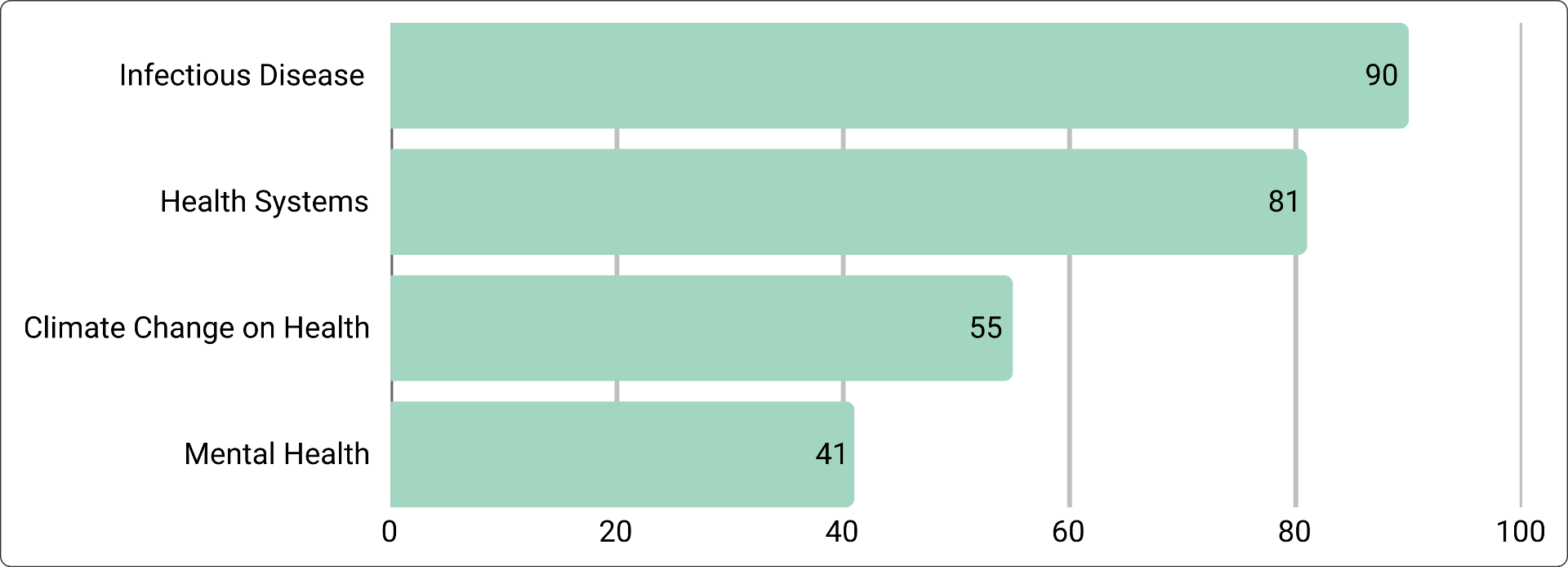
Thematic distribution of 267 eligible preliminary appliations for D4H Call for Proposals 2026 (see Figure 1).
Source notes should begin with Source: followed by the citation.
Example:
- Source: SEA DREAM Programme.
Acronyms
Acronyms should only be used after the full term has been written on its first occurrence. Once introduced, the acronym may be used consistently throughout the remainder of the document.
| First reference | Subsequent references |
|---|---|
| Southeast Asian Ministers of Education Organization (SEAMEO) Secretariat | SEAMEO Secretariat |
| Developing Research Excellence and Mentorship in Southeast Asia (SEA DREAM) | SEA DREAM |
| UK Foreign, Commonwealth & Development Office (UK FCDO) | UK FCDO |
Guidelines
- Spell out the full name on first mention.
- Do not create unnecessary acronyms.
- Avoid using abbreviations that may not be widely recognised by the intended audience.
- Use only officially accepted acronyms for organisations, programmes, and technical terms.
Regional Country Names
Southeast Asia
Use Southeast Asia (not South East Asia).
Country Names
Use the official English names adopted by SEA DREAM and Association of Southeast Asian Nations (ASEAN).
| Use | Other forms |
|---|---|
| Brunei Darussalam | Brunei (formal documents) |
| Cambodia | Kingdom of Cambodia |
| Indonesia | - |
| Lao PDR | Laos |
| Malaysia | - |
| Myanmar | Burma |
| Philippines | The Philippines |
| Singapore | - |
| Thailand | Kingdom of Thailand |
| Timor-Leste | East Timor |
| Vietnam | Viet Nam (official titles only) |
Regional References
- Avoid abbreviating "Southeast Asia" to "SEA". Use "SEA" only when it forms part of the official programme name, such as "SEA DREAM", or another officially named entity.
- Refer to member organisations by their official institutional names.