

Guidelines
Selection and Evaluation Criteria
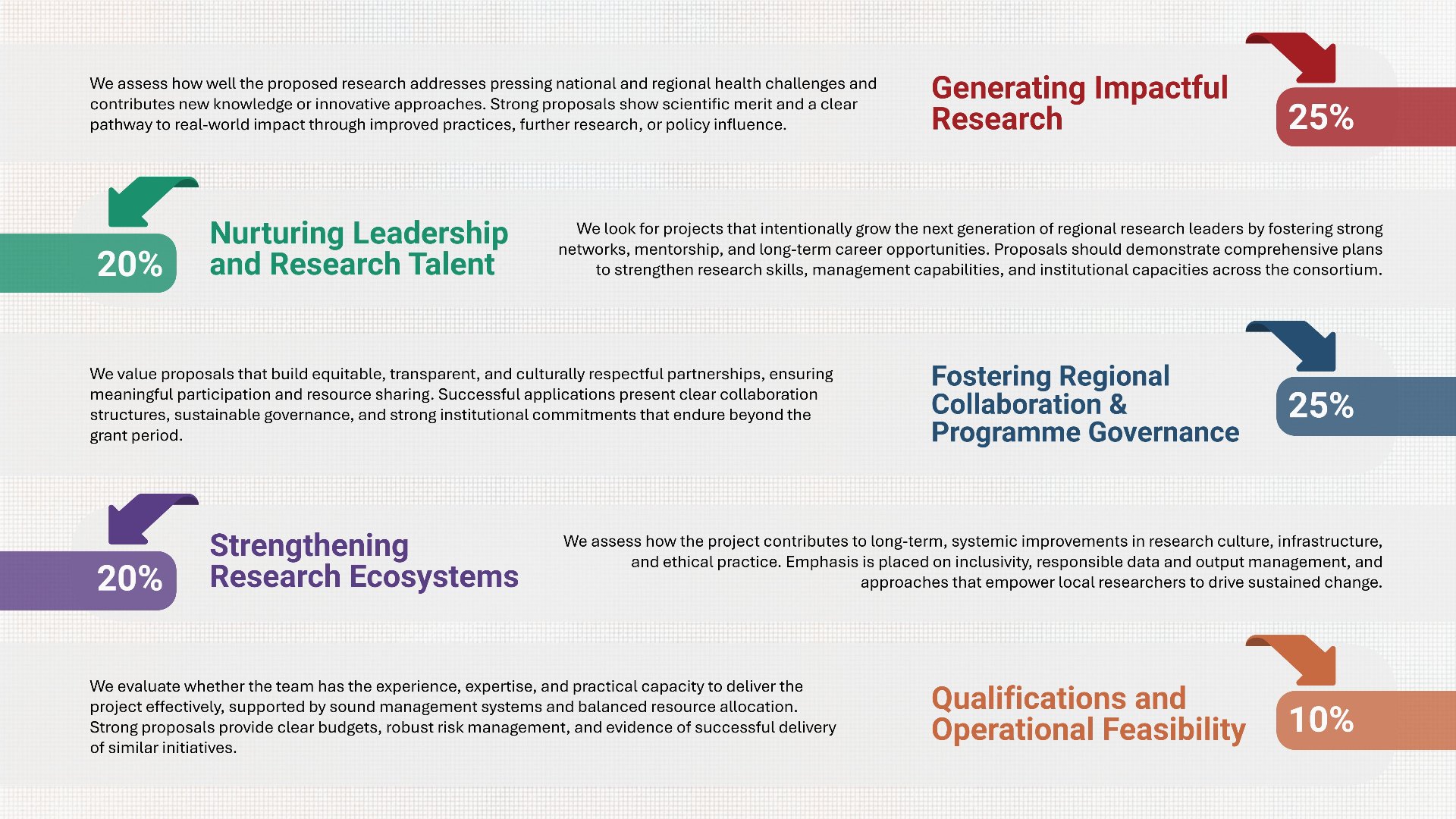
Applicants to the SEA DREAM programme will be assessed over 5 domains and their respective components as follows:
1. Generating Impactful Research (25%)
-
Relevance: The proposed activities are informed by and address national and regional health challenges fulfilling a significant gap in the existing science and literature.
-
Scientific Merit: The proposed activities develop and test concepts, methods and technologies that hold potential to contribute to scientific advancement by leveraging transformative, innovative, ethical, novel, and/or inter-disciplinary approaches informed by the relevant communities and the current evidence base, including consideration of their applicability, replicability and adaptability in LMIC settings.
-
Impact: The proposed activities include a clear and implementable impact strategy that demonstrates the potential for the research to inform further research, improve practices, inform policy and achieve real-world impact, with attention to sustainability and equitable uptake in diverse settings and resource-constrained contexts.
2. Nurturing Leadership and Research Talent (20%)
- Leadership: The proposed activities focus on leveraging the consortia in developing leaders through expansion of networks, engagement with reputable scientific communities, and attractive and long-term research career opportunities and progression.
- Skills Development: The proposed activities demonstrate a comprehensive approach across the consortia to training and mentorship to strengthen holistic research skills and capacity at individual, institutional and ecosystem level that includes research management, grantsmanship, organisational leadership, and engagement with policy making.
3. Fostering Regional Collaboration and Programme Governance (25%)
-
Equitability: Exemplary plan for equitable and meaningful partnership within consortia, especially Lower Middle-Income countries - in decision making, participation, governance and outputs. Partnerships should be transparent, grounded in mutual respect, and considerate of cultural norms and values. There should be clear evidence of resource sharing, especially for the Lower-Middle Income countries.
-
Practicality: The applicant has a clear, comprehensive strategy for regional collaboration, with well-defined roles and equitable distribution of resources among partners. There is also evidence of a sustainable partnership plan for continued collaboration post-SEA DREAM Grant period.
-
Good Governance: The application demonstrates high-level institutional commitment with strong letters of support from partner organisations. It includes a detailed multi-country stakeholder engagement plan and a tech transfer plan with institutional support.
4. Strengthening Research Ecosystems (20%)
-
Sustainability and Contribution to Systemic Change: The application demonstrates how the proposed consortium will strengthen the research ecosystem within the partnership itself, including institutional capabilities, research culture, infrastructure and environment, and enhances researchers’ ownership, agency and capability to define and address their development priorities. The application shows credible pathways for sustaining these gains beyond the grant period and outlines potential to contribute positively to national and regional research ecosystems beyond the consortium.
-
Ethical Practices: The application promotes ethical research practices and upholds integrity, transparency and credibility.
-
Inclusivity and Equity: The application incorporates a practical and robust approach to Gender, Equity, Diversity, and Inclusion (GEDI).
-
Output management: The application includes a fair output management plan that demonstrates and ensures quality, transferability, openness, and sovereignty for research data access for all outputs.
5. Qualifications and Operational Feasibility (10%)
-
Qualifications and Expertise: The qualifications, skills, and previous research contributions of the applicants will be reviewed to evaluate the experience and expertise of the grantees in: (1.1) Relevant research areas and; (1.2) Specifically within the Southeast Asian (SEA) and national context. And (1.3) The team members are suitably chosen in terms of both number and diversity of expertise, and they have experience with mentorship arrangements. The overall team configuration is designed to support the successful delivery of the project, and (1.4) Responsibilities are allocated reasonably.
-
Management Experience: The applicant has successfully managed large-scale collaborative projects and grants at a national and/or regional level.
-
Budget and Resource Allocation: The project’s achievability with the given budget is assessed through a detailed plan for resource allocation and management, including fair distribution between partners. There is a clear and feasible connection between the budget and the proposed activities, outputs, and objectives.
-
Risk Management: A comprehensive risk management strategy is in place, addressing potential challenges with proactive and innovative solutions. The plan demonstrates an ability to adapt to emerging priorities, including built-in steps to revise the approach throughout the project duration.

Get In Touch
Subscribe To
Our Newsletter
Stay up to date with our latest funding,
news, events, and announcements.