

What is the Hub-and-Spoke Model?


The hub-and-spoke model is a network structure that centralizes core functions in a lead institution while extending participation and impact through a network of partner organizations. Originally applied in fields like transportation, telecommunications, and logistics, the model has gained increasing relevance in healthcare and research for its ability to balance centralized expertise with distributed access.
In this framework, a central hub provides coordination, oversight, and advanced infrastructure, while spokes extend reach, collect data, and engage local communities. The model supports both efficiency and equity, ensuring that high standards are maintained while enabling diverse institutions to contribute meaningfully to collective goals.
The model is often visualized as a bicycle wheel: the hub sits in the middle, while the spokes radiate outward, each one connected back to the center (Phillips, 2025). This creates a distribution network that allows expertise, resources, or services to flow from the hub to the spokes and back again. It is admired for its efficiency, scalability, and organizational clarity (Guibelondo, 2025).
In healthcare and research contexts, the hub-and-spoke model has been used to extend specialized services, strengthen coordination across institutions, and support large-scale collaborative studies.
- The hub represents a central institution with advanced infrastructure and technical expertise. It oversees critical functions such as regulatory compliance, data management, training, and system-wide coordination.
- The spokes represent partner sites, often smaller, community-based, or geographically remote institutions, that focus on implementation, participant recruitment, local data collection, and eommunity engagement.
This model balances centralized oversight with distributed reach, ensuring consistency and quality control while enabling inclusion of diverse populations. In research trials, for example, the hub maintains scientific rigor and regulatory standards, while the spokes make studies accessible to broader and more representative participant groups.
As noted in studies of global health networks, the hub-and-spoke model is particularly suited to regions marked by geographic diversity, uneven institutional capacities, and resource constraints. By anchoring training, resources, and expertise in central hubs, while extending access and participation through spokes, this model fosters both equity and excellence (Guibelondo, 2025; Saleh et al., 2023).
The hub-and-spoke model offers several key advantages that make it attractive for healthcare and research applications (Visible Network Labs, 2023):
- Centralized Coordination: The hub aligns strategies, avoids duplication, and ensures all spokes contribute to shared objectives.
- Efficient Communication: Direct hub-to-spoke channels reduce confusion and enhance clarity.
- Streamlined Resource Allocation: With oversight of the full network, the hub can allocate funding, training, and tools according to need.
- Capacity Building: Peripheral institutions gain access to infrastructure and training that may not otherwise be available.
- Equitable Participation: By design, smaller or less-resourced centers can meaningfully contribute to research agendas.
In healthcare and research, the hub-and-spoke model provides a structure that enables centralized oversight and quality control while also expanding access and inclusivity. The hub ensures scientific rigor, regulatory compliance, and consistency, while the spokes make it possible to reach diverse populations and contexts. This balance allows for standardized research practices while also ensuring representation from geographically scattered or underserved populations (Bok, Noone, & Skouw-Rasmussen, 2022).
For Southeast Asia, the model is particularly relevant given the region’s geographic diversity, unequal institutional capacity, and resource gaps (Saleh et al., 2023; Woolley et al., 2017). By anchoring advanced facilities in central hubs and enabling participation through spokes, the model strengthens research collaboration, fosters inclusivity, and empowers emerging institutions.
This is why the SEA DREAM Programme adopts the hub-and-spoke model as the foundation of its consortia structure. Each consortium is required to include an Lead Organisation (hub) and multiple Co-Applying Organisations (spokes):
- The hub manages and distributes the grant funding, ensures compliance, oversees consortium activities, and serves as the primary contact.
- The spokes bring local knowledge, data collection capacity, and specialized expertise, ensuring that research is relevant, inclusive, and regionally grounded.
Every consortium must have at least three organizations from different countries, including one from a Lower Middle-Income Country. This ensures that high-capacity institutions work hand in hand with partners from less-resourced settings, creating equitable and sustainable collaborations.
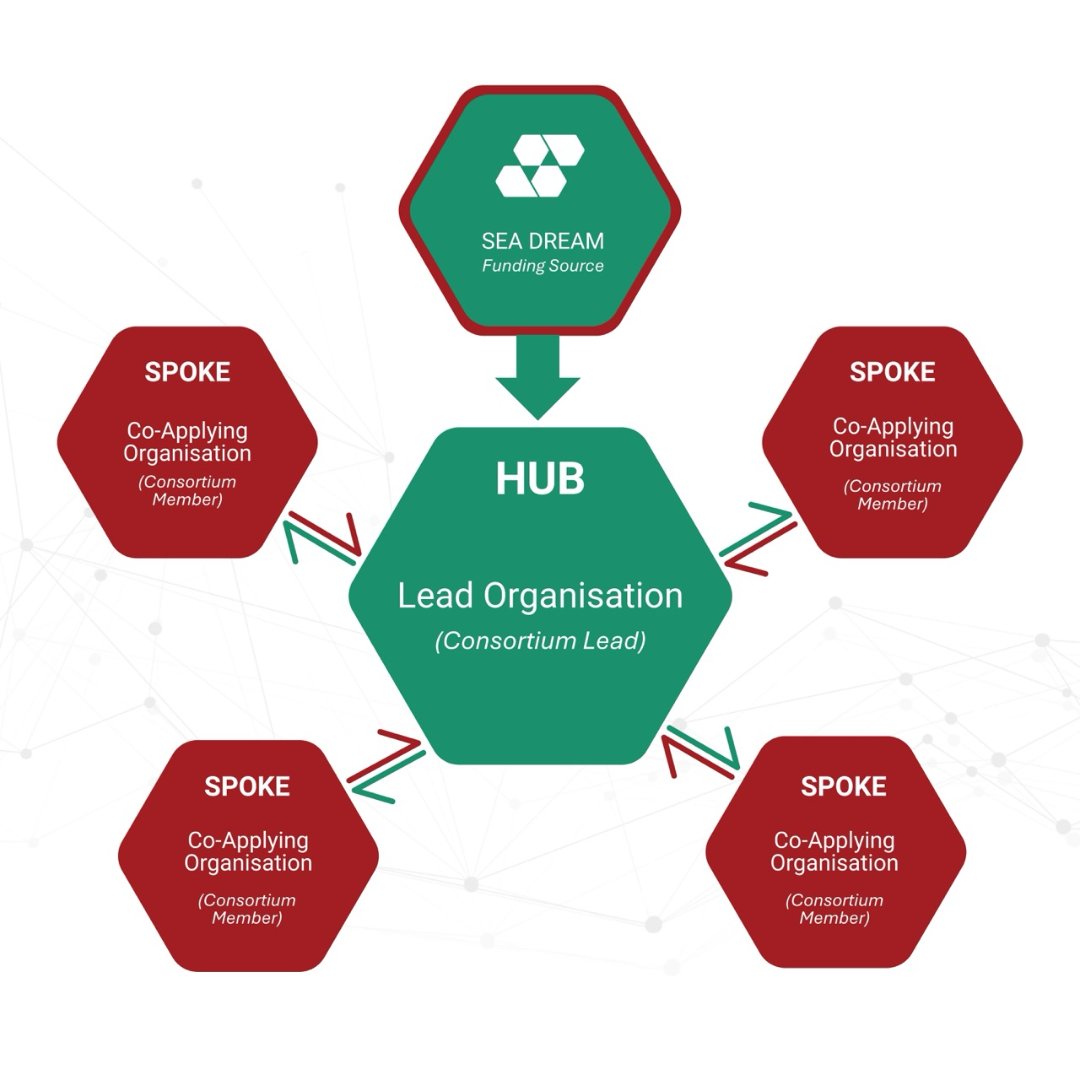
Examples of this model exist across many domains, the United Nations Secretariat coordinating its member states, airlines organizing flight routes, and community networks organizing around a backbone organization. In all cases, the hub serves as the backbone, while spokes extend reach and ensure inclusiveness.
By embedding the hub-and-spoke model into its design, SEA DREAM is not only organizing research more efficiently but also strengthening and transforming the regional research ecosystem. The model ensures that excellence at the hub is balanced by inclusive participation at the spokes, fostering collaboration, building capacity, and strengthening equity across Southeast Asia. In this way, SEA DREAM turns a logistical framework into a strategic engine for regional health research and leadership development.
References
Bok, A., Noone, D., & Skouw-Rasmussen, N. (2022, March 29). Key challenges for hub and spoke models of care – A report from the 1st workshop of the EHC Think Tank on Hub and Spoke Treatment Models. The Journal of Haemophilia Practice, 9(1), 20–26. https://doi.org/10.2478/jhp-2022-0003
Guibelondo, D. T. (2025, January 7). Streamlining clinical trials: The hub-and-spoke model in global logistics. Pharma Features. https://pharmafeatures.com/streamlining-clinical-trials-the-hub-and-spoke-model-in-global-logistics/
Phillips, M. (2025, June 16). What is the hub and spoke model? Transvirtual. https://www.transvirtual.com/blog/what-is-the-hub-and-spoke-model/
Saleh, S., Dabbous, O., Sullivan, S. D., Ankleshwaria, D., Trombini, D., Toumi, M., Diaa, M., Patel, A., Kazazoglu Taylor, B., & Tunis, S. (2023). A practical approach for the adoption of the hub and spoke model for cell and gene therapies in low- and middle-income countries: Framework and simulation case studies. ISPOR 2023. Retrieved from https://www.ispor.org/docs/default-source/intl2023/ispor23dabbousgene-therapy-lmicfinal126018-pdf
Visible Network Labs. (2023, June 5). What is a hub-and-spoke network: 9 tips, benefits & limitations. https://visiblenetworklabs.com/2023/06/05/what-is-a-hub-and-spoke-network/
Woolley, R., Robinson-Garcia, N., & Costas, R. (2017). Global research collaboration: Networks and partners in South East Asia [Preprint]. arXiv. https://arxiv.org/abs/1712.06513

Article and resources
Interesting Articles



A Silent Emergency: Understanding Mental Health in Southeast Asia

An Uneven Lifeline: Understanding Health Systems and Access to Care in Southeast Asia

An Enduring Epidemic: Infectious Disease in Southeast Asia

A Warming World: Understanding Climate Change and Health in Southeast Asia

A Shared DREAM: Advancing Health Equity in Southeast Asia
A Silent Emergency: Understanding Mental Health in Southeast Asia
An Uneven Lifeline: Understanding Health Systems and Access to Care in Southeast Asia
A Silent Emergency: Understanding Mental Health in Southeast Asia

Get In Touch
Subscribe To
Our Newsletter
Stay up to date with our latest funding,
news, events, and announcements.