

Guidelines
How to develop your theory of change?
The SEA DREAM programme requires applicants to develop a Theory of Change (ToC) to clearly articulate how their proposed activities will contribute to intended outcomes and long-term impact. A Theory of Change provides a structured approach to understanding how and why change is expected to occur, linking project activities to results through a logical and evidence-based pathway.
A Theory of Change is a process for thinking about and describing the change you want to see and how you plan to achieve that change (New Philanthropy Capital [NPC], 2019). It outlines a sequence of events that is expected to lead to a desired outcome, including the conditions, assumptions, and external factors that may influence success (Davies, 2012).
It can be understood as the underlying logic of a project, explaining how activities are expected to lead to outputs, outcomes, and long-term impact. This logic forms the foundation for the development of your project’s logical framework (logframe).
For Reference: SEA DREAM’s streamlined Theory of Change, which aligns inputs, outputs, short-term outcomes, long-term outcomes, and impact goals across four core objectives:
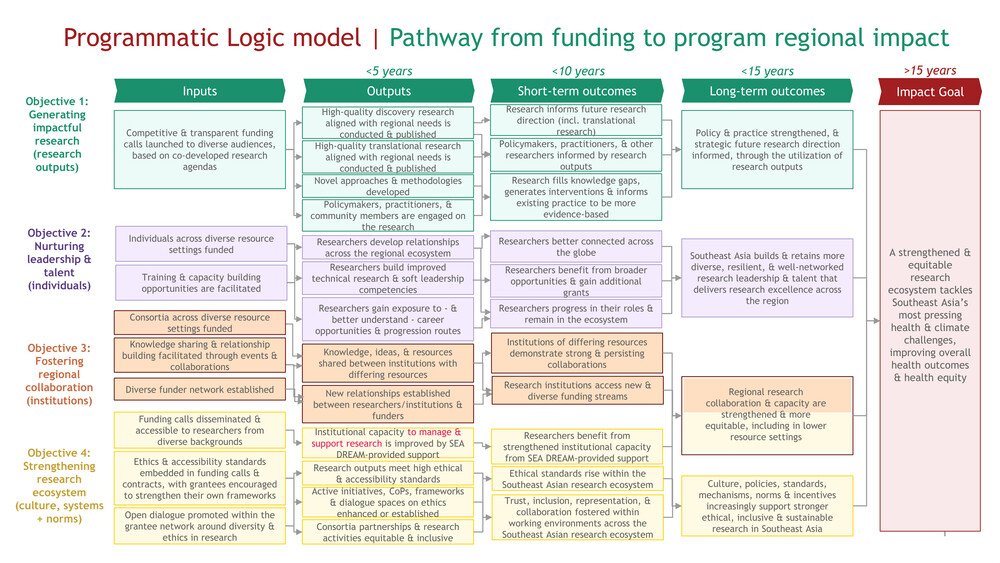
Developing a Theory of Change also supports a shared understanding of the project design, helps identify assumptions, and ensures that all components of the proposal are logically connected and aligned with intended results.
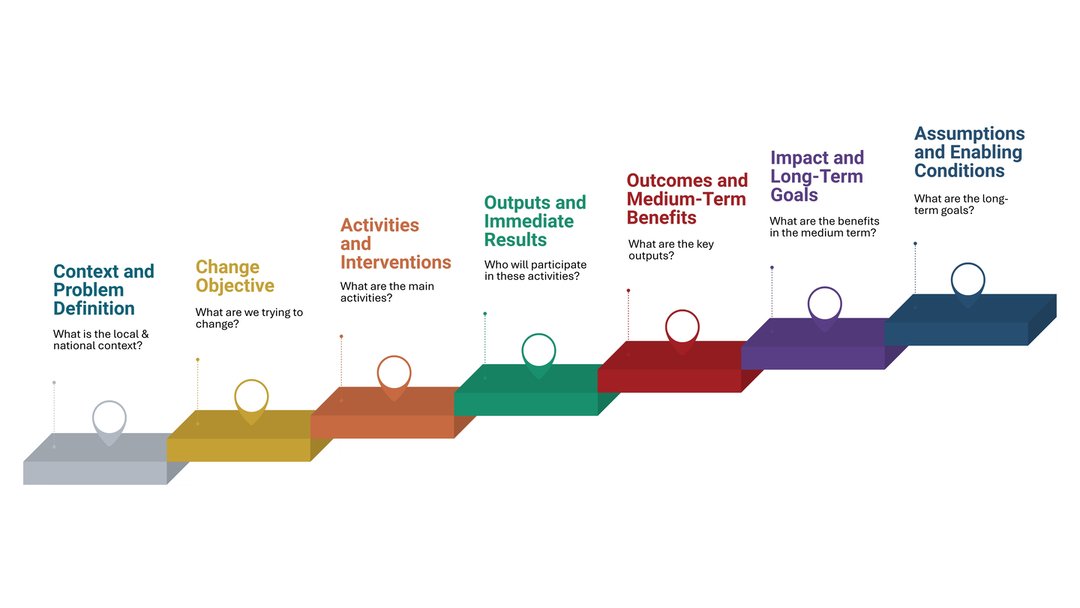
Developing Your Theory of Change
Each proposal can develop their Theory of Change in their preferred style and logic.
A common Theory of Change development approach systematically considers the following elements:
1. Context and Problem Definition
Applicants should describe the local and national context in which the project operates, including key issues, opportunities, and relevant policy or practice considerations. This should include an explanation of the problem being addressed and the factors contributing to it.
Applicants should also define what they are trying to change, including the current situation and the desired change.
2. Change Objective
Applicants should clearly describe the specific change their project seeks to achieve, including the current situation, the problem or gap being addressed, and the desired improvement. This should outline what needs to change and why it is important within the project context.
Applicants should also explain how the proposed change will be observed or measured over time, including who is affected by the issue and what evidence supports the need for change.
3. Activities and Interventions
Applicants should describe the main activities that will be implemented to achieve the intended change. This includes outlining the core interventions and explaining how they will contribute to the desired outcomes.
Applicants should also consider who will resource and deliver these activities, and what mechanisms will ensure their effective implementation.
4. Outputs and Immediate Results
Applicants should define the key outputs expected from project activities. These are the direct and measurable products or deliverables resulting from implementation, such as training sessions conducted, research outputs produced, or engagement activities completed.
Outputs should be clearly linked to the activities and provide a foundation for achieving outcomes.
5. Outcomes and Medium-Term Benefits
Applicants should describe the expected outcomes or benefits in the medium term. These represent the changes that occur as a result of the outputs and should reflect improvements in capacity, behaviour, systems, or practices.
Applicants should also consider how these outcomes will be evaluated and what evidence will be used to assess progress.
6. Impact and Long-Term Goals
Applicants should define the longer-term goals or impact of the project. This includes the broader and sustained changes that the project aims to contribute to over time.
Applicants should explain how these long-term goals relate to the SEA DREAM programme objectives and how they will be evaluated.
7. Assumptions and Enabling Conditions
Applicants should identify key assumptions underlying each stage of the Theory of Change. These include the conditions that must hold true for the project to succeed, as well as any risks or external factors that may influence outcomes.
This includes considering:
- What needs to be in place for activities to lead to outputs
- What conditions are required for outputs to lead to outcomes
- What external factors may influence long-term impact
Submission within the Full Application
The Theory of Change should be presented through a visual diagram to illustrate the relationships between different components.
Applicants may provide an optional written narrative covering:
- Problem statement
- Outputs
- Outcomes
- Long‑term impact
Applicants should ensure that their TOC presents a clear and coherent results chain. Each level should logically contribute to the next, demonstrating how and why the proposed interventions will lead to measurable change.
A summary of key questions is provided below for reference to guide applicants in writing their written narrative.
| Problem Statement | Inputs | Outputs | Outcomes | Long-term | ||
|---|---|---|---|---|---|---|
| What is the local & national context? | What are we trying to change? | What are the key outputs? | What are the main activities? | Who will participate in these activities? | What are the benefits in the medium term? | What are the long-term goals? |
| Local issues/ opportunities Previous change initiatives National and regional policy & practice issues | Current situation / landscape How will change be measured? | Initial outputs from the activities, e.g. Process redesigned Engagement events undertaken | What are the core activities that will lead to the change? How will SEA DREAM funding be utilised to support these? | Which stakeholder groups should engage in these activities? What will encourage their participation? | What outcomes would be expected within the grant-period? How will these be evaluated? | What wider benefits would be expected post grant-period? How will these be evaluated? |
| Key Assumptions | ||||||
| What has led to these local issues? | What do we know already as a starting point locally and nationally? | What will result in these activities bringing about change? | What is their role in achieving the change? | What makes these outputs achievable? | How will the activities result in these outcomes? What else needs to be in place? | What would lead to these wider benefits? Who would need to be engaged? |
Note:
- Upload one (1) file only (maximum size: 2MB)
- File name must follow this format: 13_MEL_TOC.pdf
References:
Davies, R. (2012). Criteria for assessing the evaluability of theories of change. Retrieved from:
https://mandenews.blogspot.com/2012/04/criteria-for-assessing-evaluablity-of.html
New Philanthropy Capital (NPC). (2019). Theory of change in ten steps. Retrieved from:
https://www.thinknpc.org/resource-hub/ten-steps
Theory of Change Toolkit. (2025). The complete guide to theory of change for 2025. Retrieved from:
https://toctoolkit.org/article/the-complete-guide-to-theory-of-change-for-2025
Tools4Dev. (n.d.). Logframe vs theory of change: What’s the difference? Retrieved from:
https://tools4dev.org/blog/logframe-vs-theory-of-change-whats-the-difference
University of Birmingham. (2024). Guidance for creating a theory of change. Retrieved from:
https://impact.bham.ac.uk/wp-content/uploads/2024/07/Guidance-for-creating-a-theory-of-change.pdf

Get In Touch
Subscribe To
Our Newsletter
Stay up to date with our latest funding,
news, events, and announcements.